Showing posts with label Section 5. Show all posts

Thursday, 16 May 2013

5.31 describe important uses of sodium hydroxide, including the manufacture of bleach, paper and soap; and of chlorine, including sterilising water supplies and in the manufacture of bleach and hydrochloric acid.


Sodium Hydroxide: Bleach; paper; soap
Chlorine: sterilising water; bleach; hydrochloric acid

5.30 write ionic half-equations for the reactions at the electrodes in the diaphragm cell

2 Cl- > Cl2 + 2e-
2 H+ + 2e- > H2

Really useful video:
http://www.youtube.com/watch?v=BUvnwUdtwqo

5.29 describe the manufacture of sodium hydroxide and chlorine by the electrolysis of concentrated sodium chloride solution (brine) in a diaphragm cell

Brine is NaCl solution.
In electrolysis, chlorine is created at the anode, hydrogen is created at the cathode, sodium hydroxide is left in the solution.

2NaCl + 2H2O > 2NaOH + H2 + Cl2

This happens in a diaphragm cell.

5.28 describe the use of sulfuric acid in the manufacture of detergents, fertilisers and paints

Detergents: used to 'sulphonate' products (apperently.)
Fertilisers: reacted to make phosphates soluble to plants: reacted to make ammonia easier to handle.
Paints: reacted with titanium ore to make a main pigment in paint.

http://bscstriplescience.wikispaces.com/file/view/C3_4_12+Why+is+sulphuric+acid+important.pdf

5.27 describe the manufacture of sulfuric acid by the contact process, including the essential conditions

(stage 1) S + O2 > SO2 
(stage 2) SO2 + O > SO3
(satge 3) SO3 + H2O > H2SO4


freewebs

i) a temperature of about 450C

ii) a pressure of about 2 atmospheres

iii) a vanadium(V) oxide catalyst (in stage 2)

Very helpful source:
http://namedorganicreactions.co.uk/Sulphuric.pdf

5.26 recall the raw materials used in the manufacture of sulfuric acid

Sulphur (sulphur is found in rocks and some natural gasses) and oxygen from the air and water.

5.25 describe the use of ammonia in the manufacture of nitric acid and fertilisers

Ammonia is put into fertilisers it contains nitrate ions plants need to make amino acids and so proteins plants need to grow.

Ammonia is also reacted with oxygen to produce nitric acid:
4NH3 + 8O2 > 4HNO3 + 4H2O

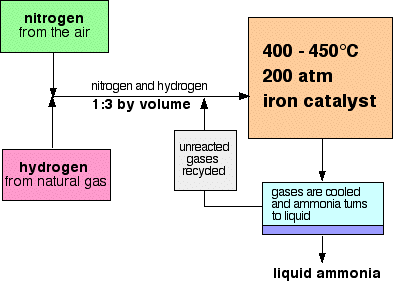
5.24 understand how the cooling of the reaction mixture liquefies the ammonia produced and allows the unused hydrogen and nitrogen to be recirculated

The products from the reactant are sent through a cooling mechanism, this is at a temperature that condenses ammonia, but not hydrogen and nitrogen. Liquid ammonia is then collected but hydrogen and nitrogen float right back into the reactor.

chemguide

5.23 describe the manufacture of ammonia by the Haber process, including the essential conditions

wikieducator

i) a temperature of about 450°C
ii) a pressure of about 200 atmospheres
iii) an iron catalyst

5.22 understand that nitrogen from air, and hydrogen from natural gas or the cracking of hydrocarbons, are used in the manufacture of ammonia

Ammonia is made by reacting nitrogen from the air and hydrogen (which comes as a natural gas or from cracking hydrocarbons.)

5.21 understand that condensation polymerisation produces a small molecule, such as water, as well as the polymer

Two monomers come together by loosing a molecule. Atoms from each monomer join together to make the molecule: commonly a H atom from one and a OH molecule from another form water. The two monomers then join together, making a polymer.

5.20 understand that some polymers, such as nylon, form by a different process called condensation polymerisation

Two monomers join together when they loose a small molecule made up of atoms from both monomers.
Commonly, an H atom from one and and OH molecule from the other form water (hence condensation reaction) and the two monomers become joined.

askmichelle

This is what happens to make nylon:

chemguide

5.19 explain that addition polymers are hard to dispose of as their inertness means that they do not easily biodegrade

Polymers are saturated so they don't react. This means they don't decompose easily.

5.18 describe some uses for polymers, including poly(ethene), poly(propene) and poly(chloroethene)

polyethene: plastic carrier bags; plastic bottels
polypropene: crates; ropes
polychlroethene: piping; cable insulation.

5.17 deduce the structure of a monomer from the repeat unit of an addition polymer

A monomer that is repeated in a polymer looks much like the repeat unit; apart from, instead of having an empty bond either end, it has a double bond in the middle.

askmichelle

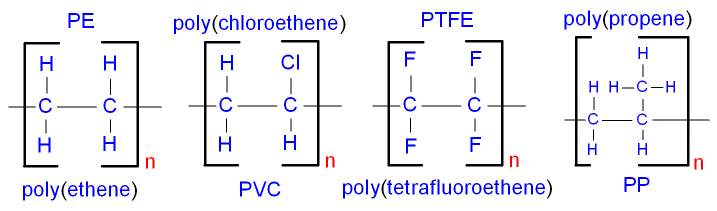
5.16 draw the repeat unit of addition polymers, including poly(ethene), poly(propene) and poly(chloroethene)

The repeat unit is the structure that is repeated to form a polymer.
(ignore PTFE on this diagram)
GCSEscience

5.15 understand that an addition polymer is formed by joining up many small molecules called monomers

monomers are alkenes with a double bond. If this bond is broken there can be other things bonded, if a carbon from another monomer is bonded in then you can create a chain; do this many times can you have a polymer.

5.14 describe how long-chain alkanes are converted to alkenes and shorter-chain alkanes by catalytic cracking, using silica or alumina as the catalyst and a temperature in the range of 600–700C.

Long chain hydrocarbons are passed over a hot catalyst (silica or alumina at 600-700 degrees) this causes them to break down into smaller molecules.

As some atoms are lost from molecules, they become unsaturated and can therefore form a double bond. This is how you get alkenes from the process as well as shorter chain alkanes.

The animation on this page is helpful:
http://www.bbc.co.uk/schools/gcsebitesize/science/aqa_pre_2011/oils/polymersrev1.shtml

5.13 understand that fractional distillation of crude oil produces more long-chain hydrocarbons than can be used directly and fewer short-chain hydrocarbons than required and explain why this makes cracking necessary

Long chain hydrocarbons are less flammable and more viscous.
Short chain hydrocarbons burn well and flow well.

Long chain hydrocarbons can be cracked which breaks them up into short chain ones.

5.12 understand that nitrogen oxides and sulfur dioxide are pollutant gases which contribute to acid rain, and describe the problems caused by acid rain

NO and SO2 are given off into the atmosphere by some industrial processes.
When they are in the atmosphere they react with rain water to create H+ ions.
When the rain falls the acid can corrode rocks and buildings. Acid can also alter the PH in soil or rivers which can effect an ecosystem.
Also acid rain corrodes limestone, which damages buildings and stuff.