C2H5OH > C2H4 + H2O
ethanol > ethene + water
aluminium oxide is the catalyst for this reaction.
Showing posts with label Section 3. Show all posts
Showing posts with label Section 3. Show all posts
Thursday, 16 May 2013

3.11 evaluate the factors relevant to the choice of method used in the manufacture of ethanol, for example the relative availability of sugar cane and crude oil
Fermentation
Hydrating (ethene and steam)
- Cane sugar widely avalible/ cheap/ renewable
- Slow process
- Impurities in the product
- Done in batches
Hydrating (ethene and steam)
- Crude oil (cracked to make ethene) expensive/ non-renewable
- Fast process
- Pure product
- Continuous reaction
3.10 describe the manufacture of ethanol by the fermentation of sugars, for example glucose, at a temperature of about 30°C
Ethanol can be made by the anaerobic respiration of microorganisms.
glucose > ethanol + carbon dioxide
This happens at 30 degrees.
glucose > ethanol + carbon dioxide
This happens at 30 degrees.
3.9 describe the manufacture of ethanol by passing ethene and steam over a phosphoric acid catalyst at a temperature of about 300°C and a pressure of about 60–70 atm
C2H4 (ethene) + H2O (steam) > C2H5OH (ethanol)
This reaction takes place at a high pressure (60-70 atm) and a high temperature (300) to make the reaction happen very quickly. Phosphoric acid also speeds up the reaction as it is a catalyst.
This reaction takes place at a high pressure (60-70 atm) and a high temperature (300) to make the reaction happen very quickly. Phosphoric acid also speeds up the reaction as it is a catalyst.
Wednesday, 15 May 2013
3.8 describe the addition reaction of alkenes with bromine, including the decolourising of bromine water as a test for alkenes
An alkene will make its double bond into a single bond, to bond to two bromines. Bromine is added to the molecule. The product made is colourless. When alkenes are put in bromine water it turns from brown to colourless (a good way of testing for alkenes.)
For example:
C2H4(g) + Br2 (aq) → C2H4Br2 (aq)
For example:
C2H4(g) + Br2 (aq) → C2H4Br2 (aq)
3.7 draw displayed formulae for alkenes with up to four carbon atoms in a molecule, and name the straight-chain isomers
In every alkene there is one double bond between two carbons. Bearing in mind that carbons can only make four bonds, then the double bonded carbons will either be joined to: another carbon and a hydrogen; or two hydrogens.
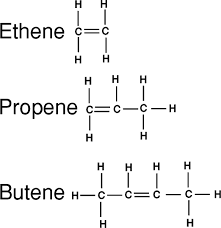
3.6 recall that alkenes have the general formula CnH2n
All compounds in the homologous group alkenes have the general formula CnH2n.
3.5 describe the substitution reaction of methane with bromine to form bromomethane in the presence of UV light.
In UV light bromine and methane will form bromomethane:
CH4 + Br2 CH3Br + HBr
What has happened in this reaction is a bromine has taken the place of a hydrogen (substitution.)
CH4 + Br2
CH3Br + HBr3.4 recall the products of the complete and incomplete combustion of alkanes
Complete combustion gives carbon dioxide and water.
Incomplete combustion gives carbon monoxide and water.
Incomplete combustion gives carbon monoxide and water.
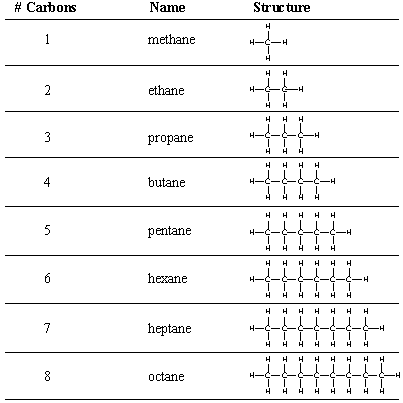
3.3 draw displayed formulae for alkanes with up to five carbon atoms in a molecule, and name the straight-chain isomers
The formula for alkanes is CnH2n+2. This means that every carbon is bonded to two hydrogens, and there is also one hydrogen on each end.
The isomers you are likely to encounter will just be this formula in a straight line (you only need up to pentane):
The isomers you are likely to encounter will just be this formula in a straight line (you only need up to pentane):
 |
| sparknotes |
3.2 recall that alkanes have the general formula CnH2n +2
Alkanes is a homologous series with the formula CnH2n +2.
What this means is that for every one carbon there are two times the amount of hydrogens plus two more hydrogens.
What this means is that for every one carbon there are two times the amount of hydrogens plus two more hydrogens.
3.1 explain the terms homologous series, hydrocarbon, saturated, unsaturated, general formula and isomerism.
Compounds in the same homologous series have the same general formula and similar chemical properties.
A hydrocarbon is a compound made up only of hydrogen and carbon.
Saturated means something has bonded as many time as possible. Unsaturated means that more bonds can be made.
General formula is the most simplified the ratio of molecules can be.
Isomers have the same general formula but different structures.
A hydrocarbon is a compound made up only of hydrogen and carbon.
Saturated means something has bonded as many time as possible. Unsaturated means that more bonds can be made.
General formula is the most simplified the ratio of molecules can be.
Isomers have the same general formula but different structures.
Subscribe to:
Posts (Atom)